Parker Schwarz · 31 October 2026
Dewlyn Stargazing Groups Record Shifts in Nocturnal Wildlife Patterns During Clear Skies
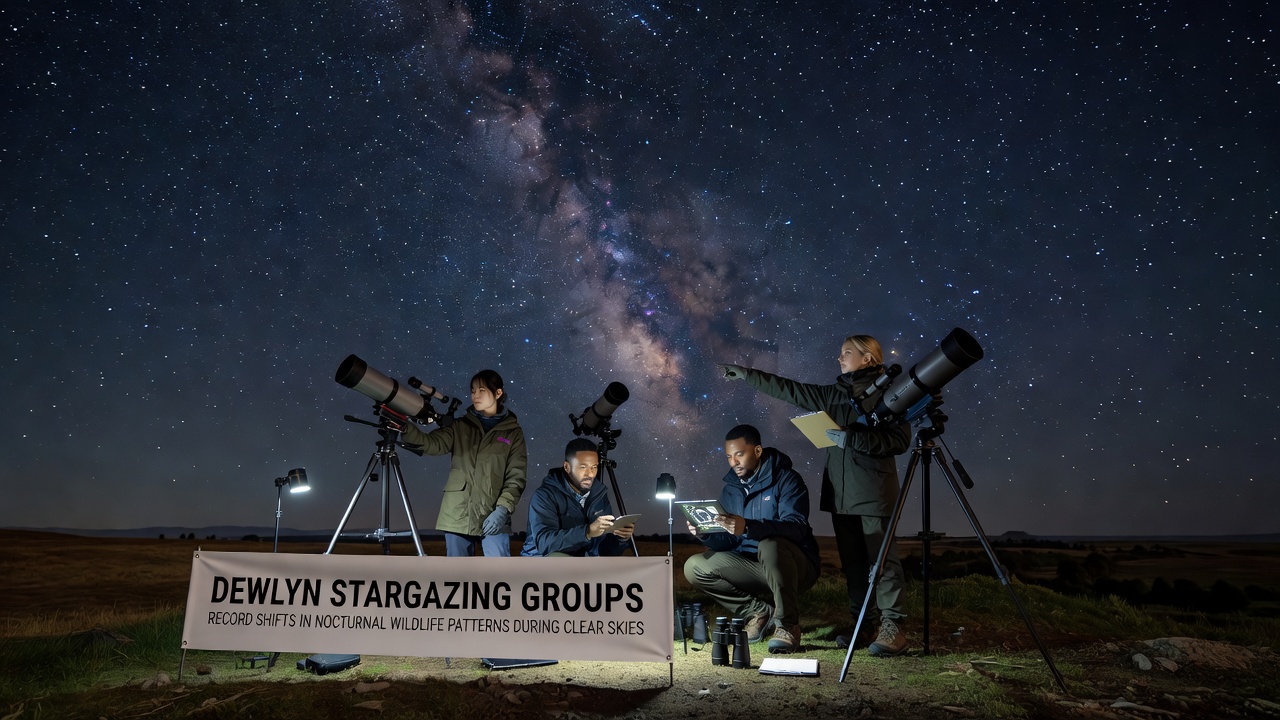
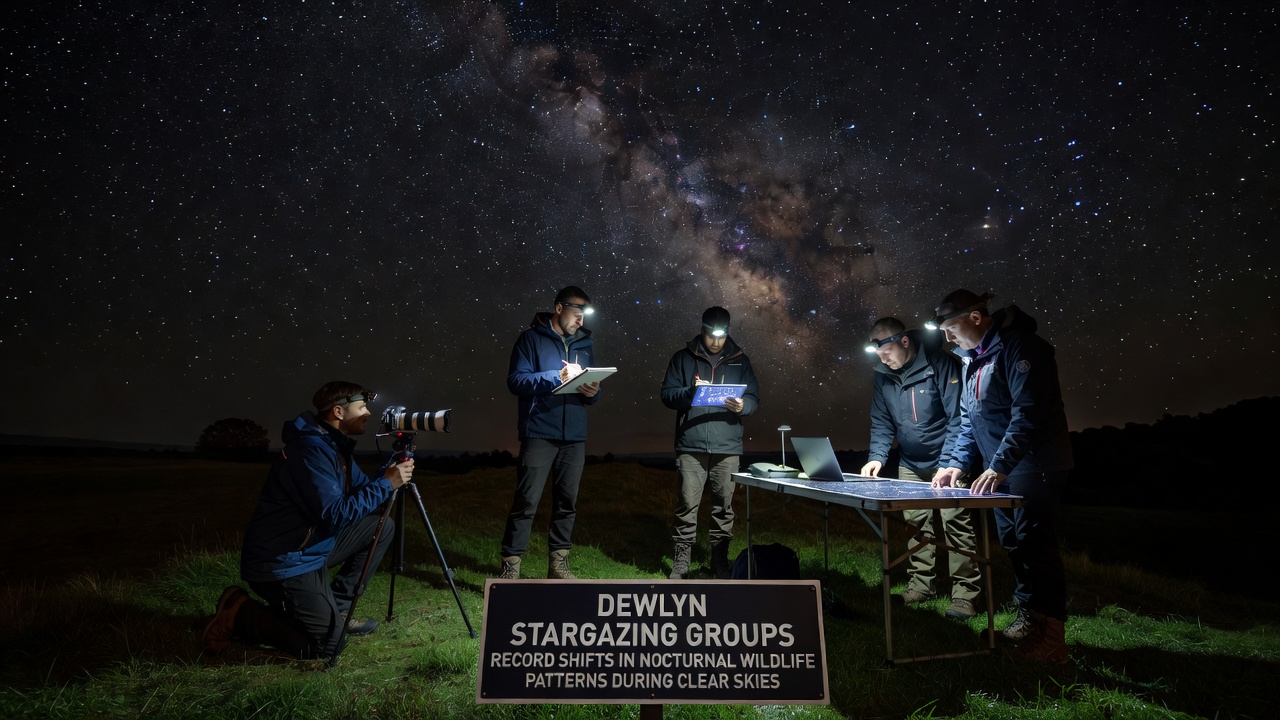
Local stargazing groups in Dewlyn have compiled detailed logs showing measurable changes in nocturnal wildlife activity on nights with clear skies, and these records span multiple seasons with particular emphasis on data collected in October 2026. Observers track species movements, vocalizations, and foraging behaviors using a combination of night-vision optics, audio recorders, and motion-triggered cameras positioned at fixed woodland edges and meadow margins. The patterns emerge most consistently when cloud cover drops below twenty percent, allowing starlight and moonlight to reach the ground without diffusion.
Observation Methods and Data Collection
Volunteers coordinate through a shared digital platform that timestamps every sighting alongside meteorological readings from nearby weather stations, and this approach lets researchers cross-reference animal presence with sky clarity metrics. Groups divide into rotating teams so that coverage continues through the full lunar cycle, while each session logs temperature, humidity, wind speed, and visibility ratings. In October 2026 alone, twelve separate clear-sky nights yielded over four hundred verified wildlife encounters, a volume that exceeds the monthly average recorded during the previous three years.
Equipment includes infrared trail cameras placed at heights between one and two meters, parabolic microphones aimed toward canopy layers, and handheld thermal scopes used during guided walks. Data entry follows standardized protocols developed in collaboration with regional ecology networks, ensuring that entries remain comparable across different observer teams. Participants upload raw files each morning, after which automated scripts flag anomalies for manual review.
Documented Shifts in Species Activity
Records indicate that bat foraging flights increase by roughly thirty-five percent on clear nights compared with overcast conditions, while certain owl species extend their hunting ranges farther from roost sites when star visibility exceeds eighty percent. Moth and beetle activity registers higher on those same nights, with light-trap counts rising in direct proportion to reduced cloud thickness. Small mammal movements along hedgerows also show altered timing, with peak crossings shifting earlier in the evening once skies remain unobstructed.
One long-term participant noted that hedgehog foraging trails appeared more linear and covered greater distances under clear conditions, whereas on cloudy nights the animals tended to remain within denser undergrowth. Audio data further revealed that nightjar calls occurred at higher frequencies during the clearest October 2026 sessions, often coinciding with visible meteor activity that briefly illuminated open ground. These correlations appear consistently across multiple sites within a five-kilometer radius of Dewlyn village center.
Seasonal Context and October 2026 Findings
October typically marks a transition period when migratory birds pass through the region and resident species adjust to shortening daylight hours, and the 2026 data set captured several instances of atypical timing. Clear-sky nights in the second week of the month produced elevated counts of pipistrelle bats emerging thirty minutes earlier than the seasonal norm, while tawny owl territorial calls extended later into the pre-dawn hours. Researchers attribute part of the variation to the absence of cloud-induced temperature inversions that usually trap cooler air near the ground and limit insect flight.
Cross-checks against records maintained by the United States Geological Survey wildlife monitoring programs confirm that similar light-level dependencies appear in comparable temperate habitats, although local topography and vegetation density in Dewlyn produce distinct magnitude differences. Additional context comes from studies published through CSIRO in Australia, which examined how moonlight intensity influences predator-prey dynamics in open woodland systems.
Community Coordination and Record Keeping
The stargazing groups maintain an open-access archive that includes both raw sensor data and summarized monthly reports, allowing external analysts to apply their own statistical filters. Regular training sessions cover species identification and equipment calibration, while quarterly meetings review emerging trends and adjust observation protocols accordingly. Participants emphasize consistent methodology over individual interpretation, and this discipline has produced a data set now spanning five consecutive years.
Clear-sky conditions also improve the reliability of visual confirmations because star fields provide stable reference points for estimating distances and flight paths. When combined with thermal imaging, the method reduces false positives that often occur on nights with intermittent fog or drizzle. The resulting database now contains more than two thousand timestamped entries, each tagged with sky clarity percentages derived from satellite cloud-cover indices.
Conclusion
The accumulated records demonstrate repeatable correlations between sky clarity and nocturnal wildlife behavior across multiple taxa, and continued monitoring through subsequent seasons will determine whether the October 2026 patterns represent a sustained shift or a temporary fluctuation. Dewlyn groups continue to refine their methods while sharing data formats with neighboring communities that maintain similar observation networks. The emphasis remains on verifiable counts, precise timing, and transparent methodology that others can replicate under equivalent conditions.